Showing posts with label authors. Show all posts

James Baldwin

Background of the author
Read about "Stranger in the Village"

Class Discussion Questions:
  1. As an essay, this piece has a rhetorical purpose. Can you identify what it is (or several)? Who do you think the audience is for this argument?
  2. What does Baldwin mean when he says, "People are trapped in history and history is trapped in them"?
  3. What are the implications of the idea that rage is not susceptible to argument?
  4. Baldwin speaks to an idea we have discussed over and over this semester: "People who shut their eyes to reality simply invite their own destruction, and anyone who insists on remaining in a state of innocence long after that innocence is dead turns himself into a monster." Are we guilty of this mistake if we try to resolve our race problems by being blind to race, by trying to define "human" regardless of race?

Virginia Woolf

Background of the author
Read about "How Should One Read a Book?"

Class Discussion Questions:

"How Should One Read a Book?"
  1. Woolf says that giving or taking "advice" about reading is ill-advised. But then she goes on to make some pretty strong-worded suggestions. Do you think she does want you to read with a particular mindset, or is the whole enterprise really wide open?
  2. In terms of reading, what does it mean "to become" an author? Can you describe what that experience might be like? Are the words we read in books a channel to the mind of an author?
  3. What activities are involved in reading even after we have put the book down?

Albert Camus

Background of the author
Read about The Stranger

Class Discussion Questions:
  1. What do you make of the narrator's emotional involvement in the world around him? Is he masking real concern, or does he truly experience one thing as more important than another?
  2. How does his response to events in his life challenge your sympathy as a reader?
  3. How does the narrative style, which in some way reflects the emotional distance of the protagonist, threaten (or enhance) your involvement in reading this novel?
  4. How does the trial change how we feel about his emotional detachment in the first part of the novel?
  5. From what point of view is Meursault narrating his own experiences? How does Camus play around with this first-person narration?
  6. What is the significance of the story about the Czechoslovakian?
  7. When Meursault looks at his reflection in the tin plate (p. 81), what does he realize? What does this discovery have to do with the narration style?
  8. Why does Meursault's lawyer use first-person to talk about his client (p. 103)? What effect does this have on Meursault?
  9. According to Meursault, what is the problem with the guillotine as a form of execution?
  10. If Meursault still has not been called to his execution by the end of the narrative (he couldn't have, right?), then what is the outcome of this story?

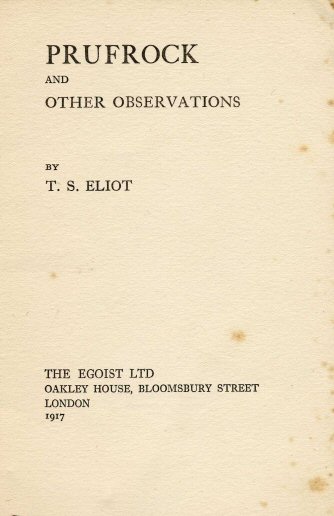
T.S. Eliot

Background of the author
Read about "The Love Song of J. Alfred Prufrock"
Read about "Tradition and the Individual Talent"

Translation of epigraph:

The epigraph comes from Dante's Inferno, Canto 27, lines 61-66. The words are spoken by one Guido da Montefeltro, who has been consigned to a suit of flame in the eighth circle of Hell as punishment for giving false counsel. He is, essentially, a liar, one who withholds or obscures the truth for personal gain at the cost of others. Interestingly, the famous literary hero Ulysses is also there, trapped in his own suit of flame for the same sin: he convinced his crew, after they had all safely returned home from war, to venture back out into open sea to look for more adventure. The ship was ultimately destroyed in a storm, and they all drowned. Here is the translation:

If I believed that my reply were made
  to one who could ever climb to the world again,
  this flame would shake no more. But since no shade

ever returned—if what I am told is true—
  from this blind world into the living light,
  without fear of dishonor I answer you.

The presence of this epigraph, followed by the ambiguous "then" in the first line of the poem, suggests that Prufrock is (a) a false counselor himself, (b) the Dantean poet who has returned from Hell to report back to us, or (c) some combination of both. Consider the last word of the poem--is Prufrock the anti-hero who invites us on a journey that ends in death?

Class Discussion Questions:

"The Love Song of J. Alfred Prufrock"
  1. You were asked to listen to T.S. Eliot read his own poem. As you listen and read along next time, mark your text when you notice the following. Have you already noticed some?
    • repeated phrase or rhythm
    • metaphors that capture an emotion
    • signs of communication breakdown
    • evidence of the speaker's self-consciousness
  2. What is the significance of the epigraph, especially considering that the poem ends with the word "drown"?
  3. Identify some words in the poem that suggest the act of writing itself. Why would this speaker use these kinds of words in a "love song"?
  4. If the speaker of this poem, Prufrock, is leading us on a journey, what kind of journey is it?
"Tradition and the Individual Talent"
  1. What does Eliot mean by "No poet, no artist of any art, has his complete meaning alone"? How does the "historical sense" relate to being part of a bigger collection of meaning?
  2. What is the catalyst analogy that Eliot explains and how does it relate to the impersonal theory of poetry (see beginning of Part II)?
  3. What kind of emotion does Eliot want to see in poetry? How can the poet achieve this kind of emotion?
  4. How can a poet be new and traditional at the same time? What does Eliot mean by "new"?
  5. How does Eliot directly respond to Wordsworth's theory of poetry in his "Preface to Lyrical Ballads"?
Significant terms from or related to the essay

Franz Kafka

Background of the author
Read about The Metamorphosis

Class Discussion Questions:
  1. If what happens to Gregor is not a dream, not an hallucination, should we hesitate to look at it symbolically? What happens to the story if we look upon this event as a symbol?
  2. Is Gregor still human after he turns into a bug? How does Kafka make this a debatable question? Does he act like a bug? Does he act like a man?
  3. Can we account for the transformation? Are we meant to consider some sort of cosmic justice or is it little more than absurd?
  4. "Was he an animal if music could captivate him so?" What can we make of this question? Does Gregor have a point of view?
  5. What is the significance of Gregor's speech being unintelligible? Does this at all reflect the absurdity of the story we are reading? Do we struggle to understand the language of this narrative?
  6. In addition, what is the significance of the assumption (except for the hired servant) that Gregor could not understand them?
  7. What are some motifs from the narrative that might help us think more carefully about Kafka's design in telling this story?

James Joyce

Background of the author
Read about "The Dead"
The Journey Westward

Class Discussion Questions:
  1. What is ironic about the first line of the narrative? What kind of irony is this? How are the narrator's words an example of free indirect discourse?
  2. What happens to the narrative voice when Gabriel finally arrives to the party?
  3. How does Gabriel see himself? What is he worried about in the first half of the story?
  4. Given his preoccupations and anxiety, what seems to be the problem with Gabriel? What is his besetting personality trait that helps explain why so much of the narrative gives us access to his mind?
  5. How does Gabriel think? Where are some other examples of the way his mind works?
  6. What two-worded descriptor does Gabriel use in the narrative, once to describe "music" and once to describe "the age"? What is the significance of this phrase in helping us understand Gabriel?
  7. How does Gabriel think of his wife when he sees her standing on the stairs? What is the name of the painting he would paint?
  8. How does Gabriel begin to think of his wife once they are on the back to their hotel? What starts to happen inside his mind, as a result?
  9. How does Gabriel respond to humiliation?
  10. Does Gabriel have an epiphany? What is he doing when it occurs? And what is the result of this epiphany, if any?

Anton Chekhov

Background of the author
Read about "The Lady with the Dog"

Class Discussion Questions:

"The Lady with the Dog"
  1. When the narrator first mentions Gurov's unfaithfulness, how would you describe the point of view and tone? Is the narrator seeing something the character does not himself see? Is there judgment in the tone? If so, where?
  2. What is free indirect discourse? Can you identify a moment in the narrative that demonstrates this technique? Consider the descriptions of women Gurov has known as an example.
  3. Look for words like "seemed" (18 times) or "as though" (14 times) or "clear" (4 times) or "probably" (6 times). What do these words suggest about the point of view in this narrative? What type of Realism is Chekhov using?
  4. Did you notice when the narrative shifted to present tense? How do we account for this narratorial intrusion? I know, big words, but you can make sense of them, right? "Narratorial" means what?
  5. Before the actual "end" of the narrative, Chekhov is sure to make us think about the idea of endings. How do these moments make the actual end of the narrative more shocking?
  6. How does this narrative demonstrate the importance of distinguishing between plot and story?
  7. Is this short story anything more than prelude to what we would really expect a story to be? How is it still a story unto itself?
"A Doctor's Visit"
  1. How is this story about (the failure of) interpretation?
  2. How would you describe the narrator in this short story? Is there any evidence that the narrator knows things that Korolyov does not know?
  3. How can Korolyov think of the devil if he does not believe in the devil? Does the doctor have a religious mindset despite his lack of belief?
  4. When speaking with the patient about her sleeplessness, which does the doctor prefer seem to prefer, in the words of Dostoevsky, "cheap happiness or exalted sufferings"?
  5. Is there good reason for a generation to be optimistic about the next?

Gustave Flaubert

Background of the author
Read about "A Simple Heart"

Class Discussion Questions:
  1. Given the fairly simple plot structure of this work, the narrative reads almost like a summary of what could have been a much more elaborate and detailed string of events. What is the effect of reading a story that does not, apparently, stop very long on any particular event?
  2. What about the details we DO get? Do they carry symbolic value, or are we expected to take the story at face value, the way would the unremarkable life of an average person?
  3. Is there a spiritual reality that Felicite can access or experience more than the other characters, or does the narrator merely suggest that she "sees" reality that way?
  4. Can we be interested in the life and struggles of Felicite? Is she interesting? If not, what are the implications of Flaubert's choice of protagonist?

Leo Tolstoy

Background of the author
Read about The Death of Ivan Ilych

Class Discussion Questions:
  1. How do the acquaintances of Ilych respond to the news of his death?
  2. Who is the narrator of this story? What attitude, if any, does he display toward the characters and action of the story? Does he pass judgment?
  3. How does Tolstoy reinforce the motif of "propriety" through the tone of the narrator? How can we tell that "propriety" is an important theme of the story?
  4. Why does this narrative begin after Ilych has already died? Why, in other words, does the narrative not start where Chapter II begins?
  5. What does Ilych want out of life, and how does he conduct himself in order to maintain this expectation?
  6. How is Ilych injured? Is this event allegorical?
  7. What kind of relationship are we encouraged to have with Ilych as we read?
  8. On what levels does Ilych see his own illness? Does it have symbolic value for him, or is his fatal condition just an unfortunate fact? And if Ivan sees his illness symbolically, does that mean that Tolstoy is inviting us to transform facts into symbols? Do we have an emotional need to do that?
  9. What direction does Ilych turn as his condition worsens?
  10. As the narration captures Ivan's desperation, are we made to feel desperate as well? Do you look for a means of escape while reading?
  11. When does Ilych begin to use his imagination? For what purpose? Does this change in thinking ultimately help Ilych? How so?
  12. What is It ?
  13. How does the narration style change as Ilych descends further and further into his suffering? Identify some unexpected strangeness in the approach to storytelling.
  14. What causes Ilych the most torment as "his last days"?
  15. The black sack, the falling stone, the railway carriage--what do these images have in common in the story? What do they indicate, being used in the narrative, about Ilych's mind?
  16. What is the one possibility, which might explain everything, that Ilych cannot at first bring himself to consider seriously? Where is Ilych's epiphany?
  17. "This consciousness intensified his physical suffering tenfold." Consciousness of what?
  18. Is this a story with a moral? Or does it have more value as an ethical exercise in distinguishing between what is true and what is false? That is, do we learn a lesson to apply to our lives or do we learn how to interpret more effectively? Or both?

Fyodor Dostoevsky

Background of the author
Read about Notes from Underground

Class Discussion Questions:

Part I
  1. We know the man is writing, literally, but to whom is he writing? How does the man feel about his audience? Do you feel like a member of his audience?
  2. In what way, according to the man, is consciousness a disease? That is, what are the symptoms of this illness? How does this idea challenge Wordsworth's confidence in reflection and the "philosophic mind"?
  3. How is a man of action different from a man overwhelmed by his own consciousness? How is the "direct" person able to act with confidence?
  4. What is the one "advantage" that the scientists and statisticians cannot take into account, the one that "upsets everything"?
  5. What is the irony of trying to figure out the formula for our desires and advantages so that we can, ultimately, reach moral perfection?
  6. Why are the man's questions near the end of section 5 and the beginning of section 9 significant? How do these questions make us think about "negative capability"?
  7. Which is better for the man underground: "conscious inertia" or moral perfection? Why?
  8. Does the man believe he has an audience? Why does he write? Were we meant to read this narrative? If not, what does it mean that we are reading it?

Part II
  1. How does the officer offend the underground man so deeply? What is the nature of his offense?
  2. Why does the man write a satirical novel about the officer? What becomes of this novel?
  3. What is the underground man's method of revenge on the "disrespectful" officer?
  4. What seems to be the man's primary urge in his dealings with other people? What does he want most to do?
  5. After hearing his tirades against Liza, do we look at the underground man's words in the first part differently? What motivates his use of words?
  6. Does the man experience an epiphany? If so, what is it, and what is the result of it?
  7. What is love to the man?
  8. Why are we repeatedly made to think about the difference between books and real life? Why would the man's words sound as if they come from a book? Why is the man's ultimate act of cruelty described as being a product "of books"?
  9. "And, indeed, I will ask on my own account here, an idle question: which is better--cheap happiness or exalted sufferings? Well, which is better?"
  10. Why should these "Notes" perhaps never have been written, according to the man? what is wrong with the novel he has written?
  11. Nevertheless, what does the underground man hope that his "audience" will look into "more carefully"? What is it that we continue to deny? What direction are we heading because of this denial?
  12. How does Part II shed light on Part I? Why doesn't Part I come after Part II in the narrative? That is, why did Dostoevsky arrange the events the way he did?

Percy Shelley

Background of the author
Read about "A Defence of Poetry"

Class Discussion Questions:
  1. Why does Shelley make a distinction between reason and imagination? Is this a productive distinction?
  2. According to Shelley, language is the most direct medium of representation. What does he mean by this claim?
  3. Is this true: "poetry is a mirror which makes beautiful that which is distorted"? Are we the ones who create order? Why is the natural state of a thing distorted?
  4. How, according to Shelley, can poetry make us better people? How can it save us from utter ruin?
  5. What are the ethical and artistic implications of the final sentence: "Poets are the unacknowledged legislators of the world"?

Alfred, Lord Tennyson

Background of the author
Read about "Ulysses"
Read about "The Lotos-Eaters"

Class Discussion Questions:

"The Lotos-Eaters"
  1. Beginning with the "Choric Song," the words are spoken (sung) by the mariners, but who is the speaker in the first five stanzas?
  2. The song the mariners sing has the form of an appeal or a persuasive argument. To whom is the argument addressed? Who needs convincing?
  3. At the end of the song, there is no return of the speaker for comment or explanation. What is the effect of ending the poem without closing the frame opened at the start of the poem?
"Ulysses"
  1. Compared to the Wordsworth poems, how does "Ulysses" convey a different brand of Romantic values?
  2. What urges Ulysses to leave home once again?
  3. Is the ambition displayed in the poem meant to be celebrated or questioned?
  4. The speaker is Ulysses himself, so there is no external commentary. Are we in a position to pass judgment on the speaker's desires? Who is his audience?

William Wordsworth

"For a multitude of causes, unknown to former times, are now acting with a combined force to blunt the discriminating powers of the mind, and unfitting it for all voluntary exertion to reduce it to a state of almost savage torpor."

Background of the author
Read about "Lines Composed a Few Miles above Tintern Abbey"
Read about "Ode: Intimations of Immortality"
Read about "Preface to Lyrical Ballads"

Class Discussion Questions:

"Lines Composed a Few Miles above Tintern Abbey"
  1. Why does the speaker repeat the word "again" in the first stanza?
  2. What is the situation in this poem? To whom is the speaker speaking?
  3. According to the speaker, how can images of nature actually temper the mind of man? Identify some examples.
  4. There is a past, present, and future in this poem. Can you explain how they are interconnected?
  5. What are "forms of beauty" and again later, "lovely forms"?
"Ode: Intimations of Immortality"
  1. Does the speaker want to be a child again? Is there an urge to return to childhood, or does the speaker celebrate something else?
  2. What advantage does the adult mind have over the "delight and liberty" of childhood?
  3. What is the "philosophic mind"?
"Preface to Lyrical Ballads"
  1. Wordsworth says that "all good poetry is the spontaneous overflow of powerful feelings," but he also tempers this statement with another. What other dimension does Wordsworth uphold as valuable? And what do these two dimensions have in common?
  2. What is Wordsworth's purpose in writing the poems found in Lyrical Ballads?
  3. I was struck by this sentence: "For a multitude of causes unknown to former times are now acting with a combined force to blunt the discriminating powers of the mind, and unfitting it for all voluntary exertion to reduce it to a state of almost savage torpor." Is this still true today? How so?
  4. What is Wordsworth's attitude toward recreational drug use?
  5. What does "recollected in tranquillity" mean?
  6. How does Wordsworth call us to responsible reading? What do we need to do in order to measure up this ethical standard?

Olympe de Gouges

Background of the author
Read about Declaration of the Rights of Woman

Class Discussion Questions:
  1. To whom is the author directing her argument, and what is the nature of reason that she is appealing to?
  2. How does the structure of de Gouges' declaration reflect Enlightenment ideals?
  3. What could be the benefit, in the face of power, of her command to "unite under the banner of philosophy"?
  4. Is de Gouges being too much of an optimist when she says, "Whatever barriers are thrown in your way it is in your power to overcome them; you simply have to want to." Does she show herself to be more a pragmatist by the end?

Mary Wollstonecraft

Background of the author
Read about A Vindication of the Rights of Woman

Class Discussion Questions:
  1. Why does Wollstonecraft concede that women are inferior to men? Who is her audience? What distinction does she make between "masculine" and "feminine"?
  2. "My own sex, I hope, will excuse me, if I treat them like rational creatures"--what do you make of Wollstonecraft's attitude toward her audience? Is her tone sarcastic or condescending?
  3. I am curious about Wollstonecraft's goal: "to show that elegance is inferior to virtue." Can she do so without merely asserting her preference that women care about the same values that she cares about?
  4. Why is Wollstonecraft up front about her use of language in this work: "I shall be employed about things, not words!"?
  5. Where do you see Enlightenment ideals in Wollstonecraft's argument?
  6. What is, according to Wollstonecraft, "the test of judgment"? What is the problem with acquiring "manners before morals"?

François-Marie Arouet Voltaire

Background of the author
Read about Candide

Class Discussion Questions:

If you seriously think about your experience reading this novel, and you are not too embarrassed to admit that you struggled, I am sure you will have questions of your own. Those are fair game as well. Please raise them in your group and call me over for help. The point is the struggle. I want you to grapple with confusion and uncertainty. Success in this course is about embracing the struggle.

The questions below will help you get started:
  1. Who is the narrator of this story? And by "who," I don't mean that you have to identify him but that you should be able to describe some of his characteristics. How would you describe the narrator in Candide? Come up with THREE strong adjectives, and identify quotes in the novel to support your choices. The narrator is not the author, though the two might have some things in common. Nor is the narrator necessarily a character in the story.
  2. What are the values of the narrator in Candide, and how does he feel about his audience? List THREE virtues or ideas that he upholds or defends and give examples of how he treats us a readers.
  3. What is the meaning of the title character's name? Is his name ironic? Does it represent a standard worth pursuing?
  4. What philosophy is being ridiculed in this satire? How does the idea of free will figure into this criticism? Identify an example.
  5. Identify some examples of poor reasoning based on Pangloss's reductive notion of cause and effect. What makes his arguments "reductive"? What happens when Pangloss tries to explain how free will is a part of the larger system of universal reason?
  6. Why does Candide begin to question that all is for the best in the best of all possible worlds? Why is his doubt a significant current in the story?
  7. How would you describe the plot of this narrative? Summarizing the story is pretty easy, but how would you describe the plot? Is the shape of the plot an element of Voltaire's satire? How so?
  8. How does the end of the old woman's story provide a thematic link to "A Modest Proposal"?
  9. What is faulty about Candide's reasoning at the end of Chapter XVI?
  10. What is the symbolic significance of the machine that carries Candide and Cacambo out of El Dorado?
  11. How does Voltaire prompt us to think about the value of art and literature in our lives? Can they make us happy? If so, how? If not, of what use are they? What would make a work of art useful?
  12. "Candide, having been educated never to judge for himself, was much surprised at what he heard." How does this passage suggest that Voltaire is using Candide, the character, to show us ourselves? What role does Martin play in Candide’s development as a character? Is their dispute enough to change how Candide thinks?
  13. Is there a "pre-established harmony," as Pangloss puts it? If so, is there also liberty? Why is it that free will is never explained philosophically in Candide? Does Voltaire demonstrate the meaning of free will in other ways?
  14. How can a story that takes on the form of trivial and fantastical fiction be taken seriously? Can we entertain that the writing of Candide is motivated by a political or ethical concern with human improvement?
  15. If we look at Candide as an allegory, what could the meaning of the story be? Does the ending of Candide finally clarify the message of the work? How does the close of this hyperactive, quick-moving narrative make us question the value of words?

Jonathan Swift

Background of the author
Read about "A Modest Proposal"

Class Discussion Questions:
  1. What is "modest" about this proposal? It would seem to be the very opposite, right? So how does the title orient us to the motivations of the author (and the motivations of the proposer)?
  2. What methods does Swift use to make sure we read this proposal on a figurative level, instead of a literal level? On the other hand, why be figurative when he could have been more literal?
  3. Identify some of the advantages put forth by the proposer. Are these advantages part of the satire (of the author), or are we meant to see them as good things, apart from the actual proposal that they are offered to support?
  4. Judging from the second to last paragraph, what is the real message of this proposal, assuming as we should that Swift does not actually want his readers to eat one year olds?